

Hearing “it’s fixed” and then seeing the same warning light, rough shifting, or engine problem come right back is maddening. If you’re dealing with the dealer says fixed but problem returns, the good news is that you do not need to start from scratch. You need a clean record, the right wording, and a way to show that this is a repeat failure, not just bad luck.
What this guide helps you do
This guide helps you get organized before the problem gets explained away. Your goal is simple: show that the defect returned, protect your warranty position, and make it easier to tell whether you’re looking at an ordinary repair issue or something more serious under Florida or New York lemon law.
That distinction matters. A one-time repair that works is one thing. A vehicle that keeps going back for the same engine, transmission, electrical, or drivability problem is something else entirely.
By the end, you should have a usable paper trail, a better dealership write-up, and a clearer sense of when repeated repairs start pointing toward a buyback, replacement, or compensation review.
What you’ll need before you start
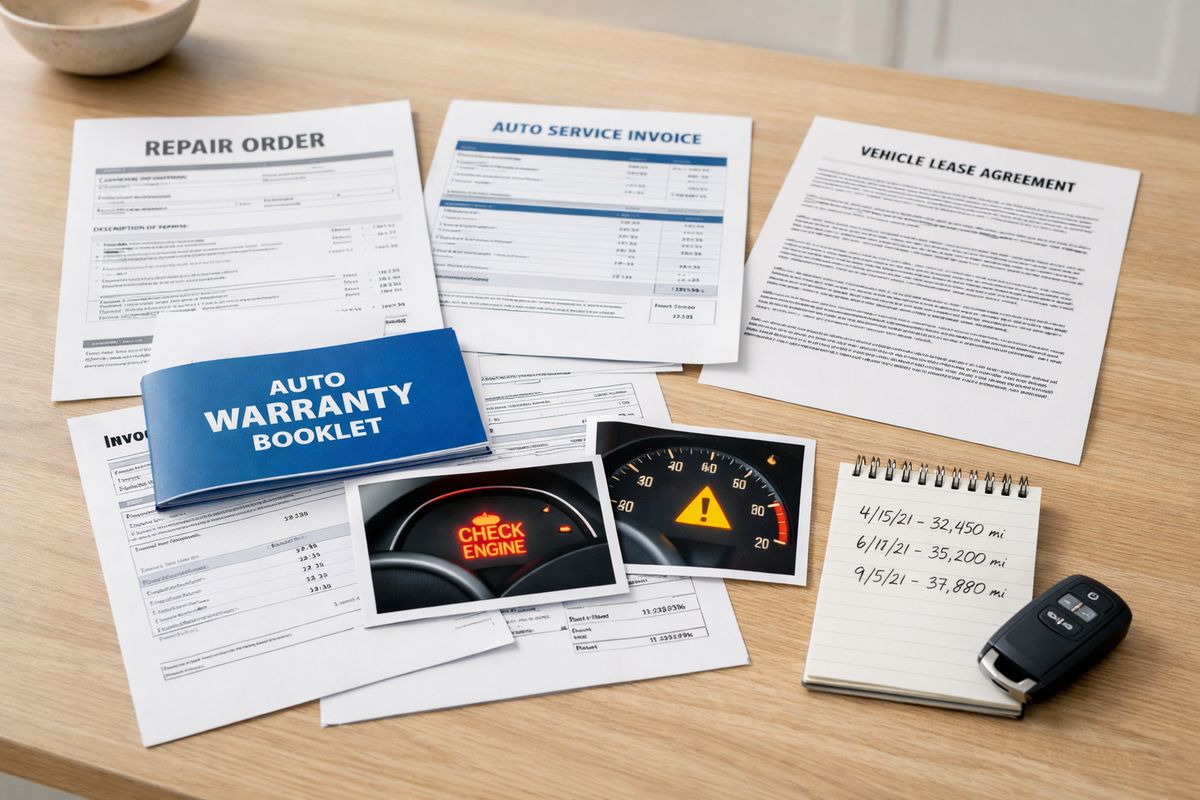
Before another phone call or service visit, get everything into one place. Think of this like laying out receipts before disputing a charge. If the facts are scattered across your glove box, phone photos, and old emails, important details get missed.
Your repair orders and invoices
Gather every repair order, final invoice, and pickup sheet from every visit. Yes, even the ones that say “could not duplicate,” “no problem found,” or “operating as designed.” Those phrases may feel useless now, but they often show that you reported the problem repeatedly.
Look for the complaint line, the diagnosis, the repair performed, the mileage in and out, and the dates. If you want a deeper look at what matters most in these records, it helps to understand which service documents tend to matter most when a defect keeps returning.
Your warranty, lease, or purchase paperwork
Pull the warranty booklet, buyer’s order, finance contract, lease agreement, and any service contract or extended coverage paperwork. You want to confirm in-service date, coverage periods, mileage limits, and any roadside or rental benefits that may apply.
If you lease, do not tune out here. A leased vehicle can still create the same repair headaches, lost time, and out-of-pocket costs as an owned vehicle.
Photos, videos, warning lights, and messages
Save clear photos of warning lights, dashboard messages, fluid leaks, smoke, or anything visible. Record short videos if the problem makes a sound, affects shifting, causes rough idle, or triggers a message and then disappears.
Specific evidence wins. A photo of a check engine light in your driveway at 7:10 a.m. before work is stronger than trying to remember later whether the light flashed or stayed on.
A simple log of dates, mileage, and days out of service
Create a basic timeline with the date the issue first started, the mileage when it happened, each repair visit, what you were told, and how many days the vehicle was unavailable. Keep it plain. One page is enough to start.
If you have not done this before, getting familiar with a simple way to organize repair proof can make the rest of the process much easier.
Step 1: confirm that the problem really returned
Before the next visit, pin down what is happening now. That sounds obvious, but this is where many cases get muddled. The dealer may treat a recurring issue like a brand-new complaint unless you connect the dots clearly.
- Read the last repair order from top to bottom.
- Compare the prior complaint to the current symptoms.
- Write a short sentence describing the match or connection.
- Note anything that changed after the last repair.
Success here looks like this: you can explain the problem in one or two direct sentences without rambling.
Compare the current symptoms to the last repair visit
Look for patterns. If the engine stalled before and now it stalls again under similar conditions, say that. If the transmission banged into gear before and now it jerks in the same speed range, note that too.
Use plain language. “Same hesitation from a stop after warm-up” is better than “vehicle still acting weird.”
Check whether the dealer wrote the complaint accurately
Repair history can go sideways because the write-up softens the problem. “Customer notes slight vibration” is not the same as “vehicle shudders and loses power merging onto highway.” If the paperwork understates the defect, the official record becomes weaker than the truth.
That matters more than most people realize. The service advisor’s summary often becomes the backbone of the file.
Separate a returning issue from a brand-new problem
Sometimes the defect is identical. Sometimes it changes shape. A replaced transmission that now leaks, slips, or throws related faults may still connect to the same underlying problem or a failed repair.
That is especially worth watching after major work. If a big component was replaced and trouble came right back, the situation starts looking less like a routine fix and more like ongoing trouble after major drivetrain work.
Step 2: stop relying on verbal promises
A calm verbal promise feels reassuring in the moment. Later, it can vanish. “You should be good now” does not help much if the paperwork says almost nothing.
- Request copies of every prior service record.
- Write down what you were told after each visit.
- Move future updates into email or text whenever possible.
The goal is not conflict. The goal is a record.
Ask for a complete copy of the prior repair record
Ask for the full repair order and final invoice from each visit. If available, ask for technician notes, test results, codes, and parts replaced. Some dealers will provide more detail than others, but it is worth asking.
When the file shows a prior diagnosis, replaced parts, or a completed repair, it becomes much easier to show that the fix did not hold.
Write down exactly what the service advisor told you
After a phone call or pickup, write the date, time, name, and what was said. Keep it short and close to the actual wording. “Advisor stated vehicle is fixed and safe to drive” is useful. “Seemed confident” is not.
Small notes made right away are usually the best ones because memory gets fuzzy fast.
Follow up by email or text when possible
If you spoke by phone or in person, send a calm summary afterward. Something simple works: “Dropping off the vehicle again for the same stalling issue that returned after the last repair on September 12.”
That single message can lock the timeline in place and reduce future arguments about what was reported.
Step 3: document the returning defect in a way the dealer cannot brush off
Vague complaints are easy to dismiss. Specific complaints are harder to ignore. Your job here is to turn “it keeps doing it” into a pattern that can be tested and written down.
- Track when the issue happens.
- Capture clear evidence if it is safe.
- Note any safety risk directly.
- Keep the description consistent from visit to visit.
Record when the issue happens
Write down the speed, road conditions, outside temperature, fuel level, whether the vehicle was cold or warmed up, and how long you had been driving. This is where many intermittent problems stop looking random.
For example, “hard shift after 20 minutes in stop-and-go traffic” is something a technician can try to recreate. “Transmission bad again” is much harder to test.
Capture audio, video, and dashboard alerts
Use your phone to record noises, slipping, warning chimes, rough idle, smoke, or messages on the dash, if doing so is safe. Short clips are best. One clear 15-second video usually beats a long explanation.
If the issue is a warning light that keeps showing up and disappearing, it helps to know what recurring dashboard alerts often point to.
Note safety concerns immediately
If the vehicle hesitates in traffic, loses acceleration, shuts off, slips badly, or refuses to shift correctly, write that down in direct terms. Do not water it down. A repeat defect that affects safety should be described like a safety issue.
That does not mean being dramatic. It means being accurate.
Step 4: return to the dealer the right way
The next visit matters. If the intake write-up is sloppy, the rest of the file often follows it. Your goal is not to tell the whole saga at the counter. Your goal is to get the exact problem documented correctly and tied to the failed repair.
- Schedule the visit and say the same issue returned.
- Review the write-up before handing over the keys.
- Correct any wording that weakens the complaint.
- Get a copy before leaving.
Use the phrase “same problem returned after repair”
Say exactly that. Those words matter because they frame the visit as a repeat repair attempt, not a fresh and unrelated complaint.
Short, direct wording helps: “Same transmission slipping returned after prior repair.” “Same engine stalling returned after dealership said fixed.”
Ask that your exact symptoms be quoted on the repair order
Before signing anything, read the complaint line. If your car bucks, stalls, surges, slips, lurches, or loses power, those words should appear. If the wording is too soft, ask for it to be corrected.
This is one of the best ways to show a repeat pattern, especially if your vehicle keeps going back for the same unresolved issue.
Request a copy before leaving the dealership
Do not leave empty-handed. Get the intake paperwork showing the date, mileage, and complaint. If the document is wrong, fix it then. It is much harder to correct later.
A crooked start tends to stay crooked.

Step 5: track how many repair attempts and shop days have piled up
At some point, the pattern becomes the story. Not the promise. Not the explanation. The pattern.
- List every visit tied to the same defect.
- Count total days the vehicle was unavailable.
- Highlight any major component replacements.
- Keep updating the timeline after each visit.
Count repeat repairs for the same defect
Group visits by issue, not just by exact wording. “Hard shifting,” “slips between gears,” and “jerks on acceleration” may all describe the same transmission problem. The dealer may phrase it differently each time, but the pattern can still be obvious.
If you are trying to sort out when multiple visits start to matter, it helps to look at how repeat visits are usually evaluated.
Add up total days out of service
Count every day the vehicle was at the dealer, waiting on parts, waiting on approval, or sitting after diagnosis. A repair delay still counts as time without your vehicle even if nobody is actively working on it that day.
This becomes especially important if your car has been unavailable for weeks at a time.
Include major component replacements
If the engine, transmission, battery pack, or another major system was replaced, put that near the top of your timeline. Big repairs tend to change how the situation is viewed, especially if the same trouble returns soon after.
When major components have already been swapped and the problem still is not solved, warranty replacements that failed to end the issue deserve special attention.
Step 6: escalate the issue beyond the service desk
Sometimes the service advisor is helpful. Sometimes the file just stalls out at the counter. If the same repair failed again, move the issue higher.
- Ask to speak with management.
- Open a manufacturer case.
- Request written updates going forward.
Ask for the service manager or fixed operations manager
Keep it calm and tight. Explain that the same defect returned after repair, the vehicle has been in multiple times, and you need a management-level review of the file. You are not there to argue about personalities. You are there to focus attention on a repeat failure.
That change alone can improve how the complaint gets handled.
Open a case with the manufacturer
Call the manufacturer’s customer care line and get a case number. Write it down. Ask for follow-up by email if possible. Once a manufacturer file exists, the problem is no longer just a local service-lane complaint.
If the issue is stretching into long delays, understanding when extended repair time starts looking more serious can help you see the bigger picture.
Ask for written updates on parts delays and next steps
If the vehicle has been sitting, ask what exactly is pending. Is it a diagnosis issue, a parts backorder, internal approval, or something else? Ask when the next update will be provided.
“Still working on it” is not a real update. You want specifics.
Step 7: protect yourself if the vehicle is unsafe or undriveable
Some problems are annoying. Some problems are dangerous. If the defect affects safety or basic reliability, act accordingly.
- Stop driving if the vehicle is unsafe.
- Use towing or roadside assistance if needed.
- Ask about a loaner or rental.
- Save every related receipt.
Stop driving it if the problem creates a safety risk
If the engine cuts out, the transmission slips badly, steering or braking feels compromised, or the vehicle loses power in traffic, do not keep testing your luck. A breakdown on I-95 or the Long Island Expressway is not the moment to prove the issue is real.
Say clearly that the vehicle feels unsafe to drive.
Ask about towing, roadside assistance, and loaner options
Check your warranty and roadside coverage. Ask whether towing is covered and whether a loaner or rental is available during repairs. If the answer is no, ask for that in writing.
Time without transportation adds up fast, especially when work, school, or family obligations do not pause.
Keep receipts for towing, rentals, and related costs
Save towing invoices, rental bills, rideshare receipts, hotel receipts if a breakdown stranded you, and any other out-of-pocket costs linked to the recurring defect. If repair delays drag on, it is smart to understand when temporary transportation costs may come into play.

Step 8: learn when a recurring repair problem starts looking like a lemon law case
Here’s the thing: not every repeated repair becomes a lemon law claim, but some absolutely do. You do not need to memorize statutes to spot warning signs. You need to look at the pattern.
- Review the number of repair attempts.
- Review how serious the defect is.
- Add up total days out of service.
- Consider whether the defect substantially affects use, value, or safety.
Florida: look at repair attempts, serious defects, and days out of service
In Florida, pay attention to repeated attempts for the same serious defect and long stretches out of service. If your newer vehicle keeps returning for the same substantial problem, or it spends an extended period unavailable, the situation may be moving beyond ordinary warranty repair.
The cleaner your timeline, the easier this is to evaluate.
New york: review repeated repairs and extended shop time
In New York, recurring defects and long repair downtime can also point toward a stronger claim. The exact facts matter, but the same core idea applies: repeated failed fixes and major lost use are not small issues.
If the dealer keeps saying the problem is fixed while your records tell a different story, pay attention to that mismatch.
New vs. leased vehicles and why lease drivers should still pay attention
A lease does not erase the problem. If your leased vehicle has a serious recurring defect, repeated repair visits, or long periods in the shop, the same basic concerns still exist. You are still losing use of the vehicle. You are still dealing with the disruption.
Do not assume lemon law issues only matter if you bought the car outright.
Step 9: avoid common mistakes that weaken your position
A strong case can get messy because of a few avoidable missteps. Most of them come from frustration. That is understandable, but the paper trail still matters.
- Do not trade the vehicle too soon.
- Do not stop reporting the issue.
- Do not treat “could not duplicate” as the final word.
Do not trade the vehicle too early if you are taking a big loss
Trading in a defective vehicle can feel like the fastest escape, especially after weeks of dealership visits. But if you dump it at a steep loss before getting the history reviewed, you may be locking in damage that could have been handled differently.
Pause long enough to understand what your records support.
Do not skip repair visits and assume the history speaks for itself
If the problem returns, report it again. A gap in the record gives room for the argument that the issue was minor, went away, or never really came back.
Annoying? Yes. Still worth doing? Absolutely.
Do not rely on “could not duplicate” as the end of the story
Intermittent defects are real. A phone charger that only works when bent a certain way is still broken. Vehicle problems can be the same way.
If the dealer says no problem found, get more specific next time, bring your records, and tighten the pattern. It helps to know what to do when the issue will not show up on command.
Step 10: get a free case review if the pattern keeps repeating
Once the same issue keeps returning, this stops being guesswork. At that point, you are organizing a claim story: what failed, how often it came back, how long the vehicle was gone, and what the dealer or manufacturer did about it.
- Gather the key documents.
- Build a one-page timeline.
- Decide what outcome you want to discuss.
Gather the documents a case review usually needs
Pull together repair orders, invoices, warranty documents, purchase or lease paperwork, towing or rental receipts, and your symptom log. Put them in date order. Digital scans are fine if they are readable.
Clean organization speeds up review and cuts down on back-and-forth.
Summarize your timeline in one page
Keep it short. Date of first problem. Each repair visit. Any major replacement. Total days out of service. Current status. That is enough to show the pattern fast.
If somebody can understand your story in sixty seconds, you have done this part well.
Be ready to explain the outcome you want
You do not need legal jargon. Just be honest about what you want reviewed: a buyback, a replacement, compensation, reimbursement, or a clearer answer about your options.
Plain facts carry more weight than dramatic language.
Troubleshooting: if the dealer keeps saying “no problem found”
This is one of the most frustrating versions of the problem because you know something is wrong, but the dealership file keeps acting like the vehicle is fine. The fix is usually more detail, not more emotion.
Recreate the conditions as specifically as possible
Describe the exact trigger: first start of the day, stop-and-go traffic, left turns after warm-up, highway speeds after 20 minutes, heavy rain, low-speed parking maneuvers, whatever fits. A ghost problem gets easier to catch when you narrow the conditions.
Specific patterns turn complaints into test plans.
Request a test drive with a technician
Ask to ride along and point out the symptom if it happens. Five minutes with the right person in the passenger seat can do more than three vague visits at the service counter.
This is especially useful with noises, hesitation, shifting complaints, and intermittent electrical issues.
Bring prior records to each return visit
Bring copies of prior repair orders and reference the earlier repair attempt directly. That shows this is not random and not new. It ties the complaint back to the same unresolved issue.
Troubleshooting: if your vehicle has been in the shop for weeks
A vehicle that disappears behind the service doors for a month creates a separate problem: delay. Even if the repair is real, poor communication and long downtime can become part of the claim story.
Ask for status updates in writing
Request written notes on diagnosis, parts status, and timing. Even a short email is useful. Written updates can expose whether the delay is caused by a real backorder, missing approval, or simple silence.
Confirm whether the vehicle is waiting on parts or waiting on approval
Those are different delays, and you want the real answer. If a part is unavailable, ask when it was ordered. If approval is pending, ask who is reviewing it and when a decision is expected.
That distinction gives you something concrete to track.
Keep counting every day the vehicle is unavailable
Do not stop the clock because the repair stalled. Keep counting days out of service until the vehicle is back in your possession and actually usable.
What you can expect if you take the next step
Once your records are organized, the whole situation usually becomes easier to evaluate. The facts start speaking louder than the dealership reassurance.
Possible outcomes: more repair attempts, buyback, replacement, or compensation
Some cases result in another repair attempt. Some point toward a manufacturer buyback or replacement. Others may lead to compensation or reimbursement for certain related costs. The right lane depends on your repair history, the type of defect, how serious it is, and how long the vehicle has been out of service.
The point is that “dealer says it’s fixed” is not the end of the conversation when the same defect comes back.
How long the process may take
That depends on how organized your records are and how quickly the manufacturer or dealership responds. A clean timeline and complete repair file can save a lot of time because the pattern is easier to review right away.
Messy paperwork slows everything down.
The one thing to try today
Start a clean timeline and gather every repair order into one folder, paper or digital. That one step can change the whole conversation because it turns frustration into proof.
Frequently asked questions
If the dealer says the vehicle is fixed but the same problem comes back, does that count as a new repair attempt?
Usually, yes. If the same defect returned after the dealer said it was repaired, the next visit should be documented as another attempt to fix that issue. Make sure the repair order clearly says the same problem returned after repair.
What if the repair order says “could not duplicate” but the problem is still happening?
That does not end the story. Keep documenting the symptom, record when it happens, and return with more specific details. Photos, videos, and a tighter description of the driving conditions can make a big difference.
Does a major repair like an engine or transmission replacement automatically solve the problem legally?
No. A major repair is not a reset button if the same trouble continues. If a replaced engine or transmission still leaves you with stalling, slipping, warning lights, or drivability problems, that ongoing history still matters.
Can a leased vehicle qualify if the defect keeps returning?
Yes. A lease does not cancel out recurring defect issues. If your leased vehicle has repeated repair visits or spends long stretches in the shop, that history can still matter for a claim review.
Should you keep driving the vehicle while waiting for the dealer to look at it again?
Only if it is safe. If the defect affects acceleration, stalling, shifting, steering, braking, or another serious function, stop driving it and ask about towing or roadside assistance. Safety comes first.
Is it a mistake to trade in the vehicle before getting the case reviewed?
It can be. Trading in too early may lock in a financial loss before you understand what options your repair history may support. If the vehicle has a long record of repeat repairs, it is usually smarter to get the file reviewed first.
Talk to jonathan about your vehicle
Jonathan D. Schwartz, the attorney behind Bad Vehicle, helps vehicle owners understand their Lemon Law options. You can have your repair history reviewed, get answers to your questions, and find out what next steps may make sense for your potential claim.
Your case review is free, and you pay no attorney fees unless you win.
Schedule your free consultation with Jonathan: https://badvehicle.com/schedule-your-consultation/
Think your vehicle may qualify?
Have your repair history reviewed and find out what options may be available under Lemon Law or warranty law.