

If you are asking does lemon law cover used cars, the short answer in Florida is usually no, but that is not the whole story. A used car can still qualify in some situations, especially if it was originally sold or leased as new in Florida and the legal window is still open.
Does florida lemon law cover used cars?
Florida’s lemon law is mainly built for new vehicles, not ordinary used-car purchases. That is the direct answer.
Here’s the catch: a vehicle being “used” at the time you bought it does not automatically end the discussion. If your car was first delivered as a new vehicle in Florida, and the defect showed up within the lemon law rights period, and the repair history meets the rules, your vehicle may still fall under the law. In plain English, the important date is often the original delivery date, not the date you bought it secondhand.
That is where a lot of confusion starts. You see “used” on the sales paperwork and assume the door is closed. Sometimes it is. Sometimes it is not.

What florida lemon law actually covers
Florida lemon law is meant to protect you when a serious defect keeps happening and the manufacturer cannot fix it within a reasonable number of attempts. The remedy is usually bigger than one more service visit. If the vehicle qualifies, the result may be a buyback or a replacement vehicle.
This law is not for every annoying rattle or routine repair. It is aimed at defects that seriously affect how the vehicle works, what it is worth, or how safe it is to drive. If you want a broader look at which vehicles can fall under Florida’s rules, that helps frame the issue before you focus on the used-car question.
Which vehicles are generally covered
Florida lemon law usually covers new vehicles, including certain demonstrator vehicles, that were purchased or leased in Florida for personal, family, or household use. Some other vehicle categories may qualify too, depending on how the vehicle was first sold and how it is classified.
The point that matters most here is simple: coverage usually starts with how the vehicle entered the market. If it began life as a new Florida vehicle and is still within the relevant legal period, a later owner or lessee may still have an argument worth reviewing.
The defect has to be substantial
The problem has to do more than irritate you. It has to substantially impair the use, value, or safety of the vehicle.
That sounds legalistic, but it is actually pretty practical. A car that stalls in traffic is a safety problem. A transmission that jerks every time you merge onto I-4 is not just “quirky,” it can affect use and value in a real way. Electrical failures that keep draining the battery, disabling warning systems, or sending your vehicle back to the dealer every other week can count too.
Think of it like a cracked phone screen versus a phone that randomly shuts off during every call. One is cosmetic. The other ruins the product.
When a used car in florida may still qualify
Used status alone is not the only question. Timing, original sale status, warranty coverage, and repair history matter more than the used label by itself.
If your car was first sold as new and the rights period is still open
A later buyer can sometimes step into a vehicle that is still inside the lemon law rights period. The law focuses on when the vehicle was originally delivered to the first owner or lessee, not on when it changed hands later.
That means a recently resold vehicle could still be within the legal timeframe if the original delivery happened recently enough. The clock does not restart when the car is resold, but it also does not vanish just because you bought it used. If your vehicle is a 2024, 2025, or 2026 model and the repair problems started early, this issue deserves a close look.
If you bought a dealer demo, certified pre-owned, or recently resold vehicle
Dealer labels can make a vehicle sound more protected than it really is. “Certified pre-owned” sounds reassuring, and sometimes it does come with useful warranty coverage, but certification by itself does not create lemon law rights.
Same with a dealer demo. A demonstrator vehicle may qualify in some situations because it may still count as having been sold in a way that fits the statute. A recently resold vehicle can also be worth reviewing if the original delivery date and defect timeline line up.
The trick is to separate marketing language from legal status. “Certified,” “dealer-inspected,” and “like new” are sales terms. Lemon law coverage depends on the underlying facts.
If you leased instead of bought
A leased vehicle can qualify under Florida lemon law if the other requirements are met. That matters because lessees often get brushed off, even when the vehicle has the same repeated defects and the same long shop stays as a purchased car.
If your lease vehicle keeps going back for the same problem, do not assume fewer rights just because you do not hold title. In many cases, the better question is whether the defect and repair history fit the law. This becomes even more relevant if your vehicle has been in and out of the shop for repeated defects under a lease.
When florida lemon law usually does not cover a used car
Some situations are usually outside Florida lemon law, even if the vehicle has a miserable repair history.
Private-party used car purchases
If you bought the vehicle from an individual instead of through a dealer or lease arrangement, Florida lemon law usually is not designed for that transaction. Private used-car sales are a different animal.
That does not always mean you have zero rights. Other claims may exist depending on the facts. But classic lemon law protection is generally not aimed at a normal private-party used sale.
Problems that start after the legal time limits expire
Timing matters more than most people realize. A vehicle can have a truly awful defect, but if the defect appears too late or required notice is given too late, lemon law rights may disappear.
This is one of the toughest parts for frustrated drivers. You can have a stack of repair invoices and still miss the legal window. Ugly repair history alone is not enough.
Wear-and-tear, abuse, neglect, or unauthorized modifications
Florida lemon law is not a fix for ordinary aging. Worn brakes, old batteries, tire wear, and similar maintenance issues usually do not qualify. Neither do problems caused by poor maintenance, accident damage, misuse, or aftermarket modifications that contribute to the defect.
In practical terms, if the transmission failed because of a manufacturing defect, that is one thing. If the issue traces back to neglected fluid service, racing use, or an unsupported tune, that is another.
The time limits and repair attempt rules that matter most
For many 2024 to 2026 vehicle owners, this is where the case gets clearer fast. You need to know when the rights period started, how many repair chances the manufacturer got, and how long the vehicle was out of service.
The lemon law rights period
Florida’s lemon law rights period is tied to the vehicle’s original delivery date. That is the date the first owner or lessee received the vehicle as new.
The big point is easy to miss: the clock does not restart because the vehicle was resold to you. If you bought a used 2024 vehicle in 2026, the legal timeline may already be partly gone or fully expired depending on the original in-service date and what happened before you bought it.
Reasonable number of repair attempts
The law usually expects the manufacturer to get a reasonable number of chances to fix the problem. That can mean repeated attempts for the same defect, or a long total time out of service for one or more substantial issues.
There is no magic feeling here. Dates, visits, and repeat complaints matter. If you are trying to gauge how many trips to the dealer may be enough, focus on the actual repair record, not the promises made at the service desk.
A vehicle that spends weeks at the dealership, especially for the same unresolved issue, often deserves closer attention. So does a car that gets an engine or transmission replacement and still is not right afterward.
Why repair orders and dates can make or break a claim
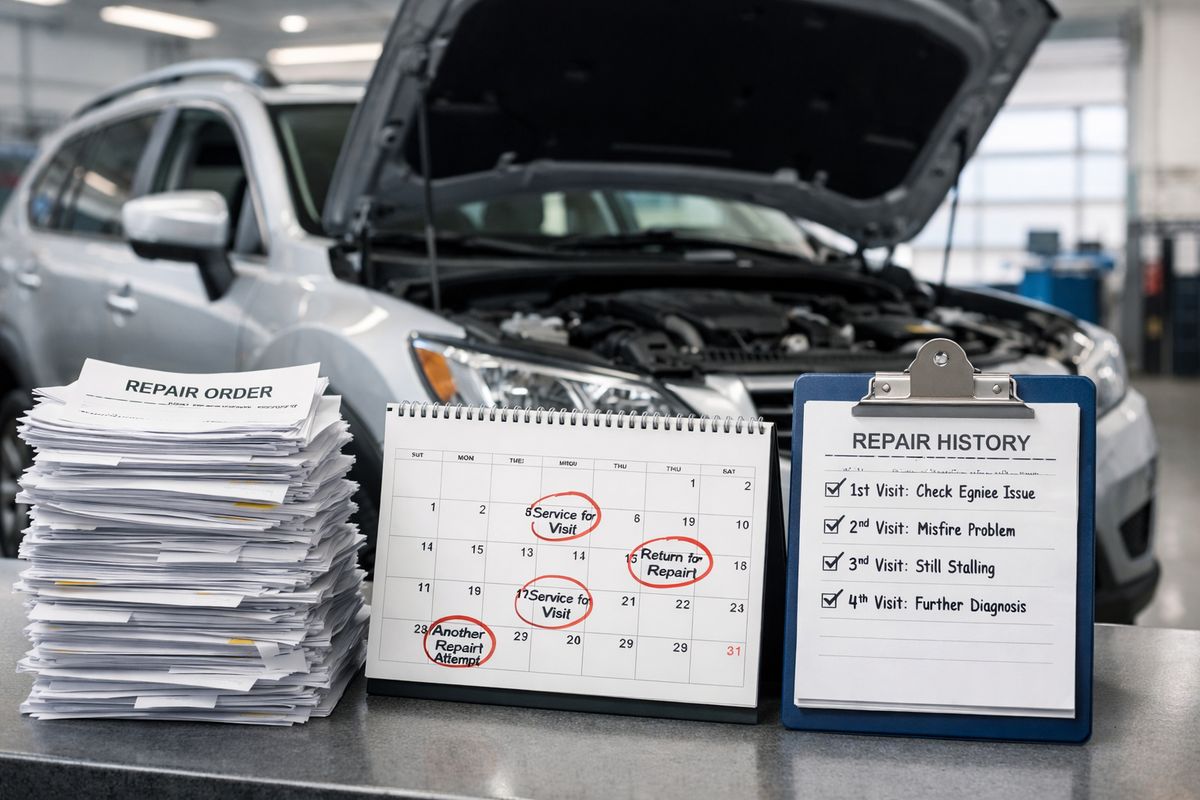
Paperwork is where strong cases get built or lost. Every repair order should show the date, mileage, your exact complaint, what the dealer found, and when the vehicle was returned.
Consistency matters a lot. If one visit says “hard shift from stop,” another says “hesitation,” and another says “won’t accelerate,” the record can look scattered even if you are describing the same transmission problem. That is why keeping the right documents and a clean paper trail can make such a difference.
Lemon law vs. used car warranty: the catch most people miss
A lot of people mix up lemon law rights and warranty rights. They overlap, but they are not the same thing.
Lemon law is a legal remedy for a qualifying defective vehicle that cannot be fixed after a reasonable number of attempts. A warranty is a promise to repair certain covered problems for a certain time or mileage. One is about fixing. The other can be about undoing the deal.
Manufacturer warranty coverage
A used car may still be protected by the factory warranty even if lemon law relief is unavailable. That matters because repeated warranty repairs can still strengthen your position, especially when the same defect keeps coming back.
If your dealer keeps attempting warranty repairs without solving the problem, that can still support other claims or settlement discussions. It also helps to understand what it means when a warranty repair still does not solve the problem.
Dealer warranties and “as-is” sales
A dealer warranty is a dealer’s promise to fix certain problems for a limited time. An “as-is” sale is basically the opposite. It means you are taking the vehicle largely in its present condition, with much more risk on your side.
That distinction matters with used cars. A dealer-backed promise may give you some practical repair rights. An as-is deal may leave you with far fewer options, especially if no manufacturer coverage remains.
Extended warranties and service contracts
Extended warranties and service contracts can help pay for repairs, but they are not lemon law rights. They do not automatically force a manufacturer to buy back the vehicle.
Think of them as repair-payment tools, not defect-resolution laws. They may cover parts and labor for certain failures, but they often come with exclusions, deductibles, or limited repair networks. Helpful, yes. A substitute for lemon law, no.
What to do if your used car keeps going back to the shop
When your car keeps returning to the dealership, frustration can turn into confusion fast. The best move is to get organized before another repair visit blurs the timeline.
Keep every repair order and match the wording each visit
Use simple, repeatable language when describing the issue. If the transmission slips when accelerating from a stop, say that each time if that is what is happening. If the engine stalls at red lights after warming up, keep the wording close to that.
The goal is to show one unresolved defect, not ten loosely related complaints. If you are stuck in the cycle of returning to the dealer for the same problem again and again, consistency in your paperwork matters more than most people think.
Give the manufacturer proper notice
Before stronger remedies become available, the law usually expects the manufacturer to get one last meaningful chance to fix the problem. That usually means formal notice, not just another verbal complaint at the service counter.
This step matters because a case can weaken quickly if notice was never properly given. Save copies of anything you send and note the dates carefully.
Ask the right qualification questions early
Before you spend more time, gather the basic facts that shape most case reviews: your year, make, and model; whether you bought or leased; the purchase or lease date; current mileage; how many repair visits happened; how many total days the vehicle has been out of service; and whether the engine or transmission has been replaced.
Those details tell the story faster than emotion alone, even if the frustration is completely justified.
What you may be able to get if the vehicle qualifies
This matters because the possible outcome is not just another repair appointment.
Buyback
A buyback means the manufacturer repurchases the vehicle. In plain English, that can mean you get out from under a bad vehicle instead of being told to come back next Tuesday.
Depending on the case, certain deductions may apply, such as for mileage or use. If you want a clearer picture of how repurchase outcomes can work for Florida drivers, compare the buyback path against your repair history and warranty status.
Replacement vehicle
Sometimes a replacement vehicle is offered instead of a refund. Some drivers like that option because it keeps them in a vehicle without starting the shopping process from scratch.
Others would rather get out completely, especially after months of breakdowns, towing, and missed work. The better option often depends on how much confidence you still have in the brand and how the numbers work out.
Cash compensation or other warranty-based relief
Even if classic lemon law relief does not fit, recurring defects under warranty can still lead to compensation, additional repairs, reimbursement, or another negotiated result. Not every valid vehicle claim ends with a repurchase.
That is especially true when the legal facts are close, or when the case is stronger under warranty law than under the narrow lemon law timeline.
Common questions about used cars and florida lemon law
A few questions come up over and over because the used-car issue is rarely black and white.
Does a certified pre-owned car count under lemon law?
Not by certification alone. A certified pre-owned car does not automatically qualify or automatically fail. The real issues are when the vehicle was originally sold as new, whether the rights period is still open, and what warranty and repair history exist.
Does an engine or transmission replacement help a claim?
It can. A major component failure often supports the seriousness of the defect, especially if the vehicle still has problems after the replacement. A replaced transmission that still jerks, slips, or hesitates is not a small detail.
What if the dealer says “that’s normal” but the problem keeps happening?
That brush-off happens all the time. If the issue keeps happening, keep documenting it and keep the wording consistent. It also helps to understand what that “normal” response often means in practice, especially when the vehicle behavior is obviously not normal to you.
Can you trade in the vehicle instead?
You can, but it often means eating the loss yourself. Trading in a defective vehicle can reduce what you get for it, especially if the market or appraisal catches the history. Before doing that, look closely at why trading away a bad vehicle can cost real money.
How to tell if your situation is worth a case review
At a certain point, the question stops being “is this annoying?” and becomes “is this worth formally reviewing?” For many frustrated Florida drivers, that point comes sooner than expected.
Strong signs your case may be worth reviewing
A case review is usually worth it when your vehicle is from 2024, 2025, or 2026, the same problem keeps coming back, the vehicle has spent weeks in the shop, or the engine or transmission has failed or been replaced. Active manufacturer warranty coverage helps. A leased vehicle with ongoing defects can also be worth a closer look.
One strong sign stands above the rest: you have given the dealership multiple chances, and the vehicle still is not right.
The one thing to do next
Pull together your year, make, and model, your purchase or lease date, the repair count, the total days out of service, and any records showing major repairs like an engine or transmission replacement. That gives you a much clearer answer, fast.
Talk to Jonathan About Your Vehicle
Jonathan D. Schwartz, the attorney behind Bad Vehicle, helps vehicle owners understand their Lemon Law options. He can review your repair history, answer your questions, and help you determine the next steps for your potential claim.
Your case review is free, and you pay no attorney fees unless you win.
Schedule your free consultation with Jonathan: https://badvehicle.com/schedule-your-consultation/
Frequently asked questions
Does florida lemon law cover a used car bought from a dealership?
Usually not just because it was bought from a dealership. The bigger questions are whether the car was originally sold or leased as new in Florida, whether the lemon law rights period is still open, and whether the defect and repair history meet the rules.
Can a second owner use lemon law rights in florida?
Yes, in some situations. If the vehicle was first delivered as new in Florida and the legal period has not expired, a later owner may still have a claim based on the original delivery timeline.
Does the lemon law clock restart when a used car is resold?
No. The clock is generally tied to the original delivery date when the vehicle first went into service as new. Resale does not create a fresh lemon law period.
If the car is still under factory warranty, does that mean it is a lemon?
Not automatically. Factory warranty coverage helps with repair rights, but lemon law requires more than active warranty status. The defect must be substantial, and the manufacturer must have had a reasonable number of chances to fix it.
Is a leased used vehicle treated differently?
A lease does not block a claim by itself. If the vehicle otherwise fits the legal requirements, a leased vehicle may qualify. The key facts are still the original sale status, timing, warranty coverage, and repair history.
What if your car has been in the shop for weeks but no one can fix it?
That can be a strong warning sign, especially if the problem is substantial and well documented. Long periods out of service, repeated repair visits, and unresolved major defects are exactly the kinds of facts that deserve a closer review.
Think your vehicle may qualify?
Have your repair history reviewed and find out what options may be available under Lemon Law or warranty law.