

A warranty repair not fixed situation means your vehicle went in for a covered repair, the dealer tried to fix it, and the problem either came back, never fully went away, or turned into something closely related right after. If you picked up your SUV in Orlando on a Thursday, felt relieved for one evening, and saw the same warning light again by Friday morning, you already know how frustrating this can get.
What “warranty repair not fixed” really means
In plain English, it means the repair did not solve the real problem.
That sounds obvious, but dealerships and manufacturers often frame it differently. A service department may say the repair was completed, that no codes are present now, or that the vehicle is operating normally. None of that changes the basic issue if your car still stalls, jerks, overheats, slips between gears, or keeps going back to the shop for the same complaint.
Sometimes the failure is easy to spot. The check engine light comes back. The transmission shudders again at 40 mph. The engine makes the same knocking sound after a major repair. Other times it is more slippery. The vehicle feels unsafe, unreliable, or obviously worse, but the paperwork uses vague language that makes it look minor.
Here’s the thing: a warranty is not just a promise to try. It is a promise to repair a defect covered by the warranty. If the same issue keeps showing up, the core problem may still be unresolved.

When an unfixed warranty repair turns into a bigger problem
At first, this feels like a hassle. After the second or third failed repair, it becomes something else entirely.
You lose time. You miss work. You rearrange school pickup, family plans, and appointments because your vehicle is back in the shop again. Rental costs can pile up, even when some days are covered and others are not. And the longer it goes on, the more your confidence in the vehicle starts to disappear.
That loss of confidence matters more than people think. A car that technically runs but feels unreliable is hard to live with. You start listening for every noise at stoplights. You think twice before taking I-4 in heavy traffic. You wonder if trading it in is the only way out, even if that means eating thousands of dollars just to move on.
The most common situations behind this phrase
A lot of unresolved warranty cases follow familiar patterns. The engine keeps misfiring after repairs. The transmission slips, hesitates, or jerks even after a software update or full replacement. A major part gets swapped, but the same symptoms return. The dealer writes “could not duplicate concern” even though the issue happens in real life. Or the vehicle sits for weeks waiting on parts while you make payments on something you cannot use.
If that sounds familiar, it helps to understand why the same problem can keep returning. In many cases, the issue is not one bad visit. It is a pattern.
What counts as “not fixed”
“Not fixed” does not only mean the exact same dashboard light turns back on.
It can also mean the root cause was never solved, the dealership insists the behavior is normal when it clearly is not, or the vehicle stays out of service so long that it might as well still be broken. If your transmission was replaced and now the shudder is gone but harsh shifting and delayed engagement take its place, that may still point to the same unresolved defect. If your engine was replaced but the vehicle still stalls or throws related codes, the repair result still matters more than the label on the invoice.
How warranty repair rights usually work
Warranty rights are easier to understand when you separate two ideas. First, the manufacturer promises to repair certain defects during the warranty period. Second, if those repair attempts do not actually fix the vehicle, you may have rights beyond “try again.”
That distinction matters. A dealership visit is the repair process. Your legal rights are about what happens when that process fails.
If you are trying to make sense of that overlap, it helps to see how a claim can exist while the vehicle is still under warranty. The warranty does not cancel your other rights. In some cases, it is exactly what triggers them.
Written warranty vs. implied warranty
A written warranty is the actual coverage booklet or manufacturer promise that says certain repairs will be made for a certain time or mileage. That is the easy one to spot.
An implied warranty is more basic. It is the common-sense expectation that a newer vehicle should work the way a normal vehicle should work. It should start, run, shift, steer, and stop in a reasonably reliable way. You should not have to accept a nearly new vehicle that spends more time in the service lane than in your driveway.
Service contract vs. factory warranty
A service contract is not the same thing as the factory warranty.
A factory warranty comes from the manufacturer and is part of the vehicle coverage. A service contract is usually something extra you bought, often through the dealer, to cover certain repairs after or alongside the original warranty. Different rules may apply, and the company responsible may be different too. A paid protection plan can help with repair costs, but it is not the same as the original manufacturer promise.
Why the manufacturer matters, not just the dealership
The dealership is usually the place doing the hands-on work, but the manufacturer is often the party behind the warranty obligation.
That is why unresolved cases frequently move beyond the service advisor’s desk. The dealer may attempt the repair, document the complaint, and communicate with the factory, but the larger responsibility often traces back to the company that issued the warranty in the first place.
How many repair attempts is “enough”?
This is the question almost everybody asks, and for good reason.
There is no magic sentence on a repair order that decides everything. Still, repeated failed attempts, serious defects, and long periods out of service can all point to a vehicle that has not been properly repaired under warranty.
Repeated repairs for the same issue
Multiple visits for the same defect usually make a case stronger, especially when the issue affects use, value, or safety. If your car has been back three, four, or five times for the same transmission problem, that history matters. So does a pattern of “repaired” followed by another breakdown a week later.
If you want a closer look at how repeat visits are evaluated, read about how repair history can start to add up. The exact number is not the whole story, but it is rarely irrelevant.
Long time in the shop can matter too
Some vehicles do not rack up many separate repair attempts because they never leave the shop long enough to come back again. That still counts for something.
If your car sits at the dealership for weeks waiting for diagnosis, authorization, or a backordered part, that can point to a serious warranty failure even without a long stack of separate invoices. Time without your vehicle is not a side issue. In a lot of cases, it is one of the strongest facts.
Safety defects usually move faster
Safety-related problems tend to carry more urgency than minor annoyances.
Brake failures, steering issues, stalling in traffic, airbag warnings, overheating, and sudden loss of power are not the kind of problems you are expected to shrug off while the dealership keeps guessing. A defect that puts you at risk tends to get more attention, and it should.
What to do if the dealer still Hasn’t fixed your vehicle
When a repair still has not solved the problem, the goal is simple: build a clean record of what happened and avoid muddying the story.
Keep every repair order and invoice
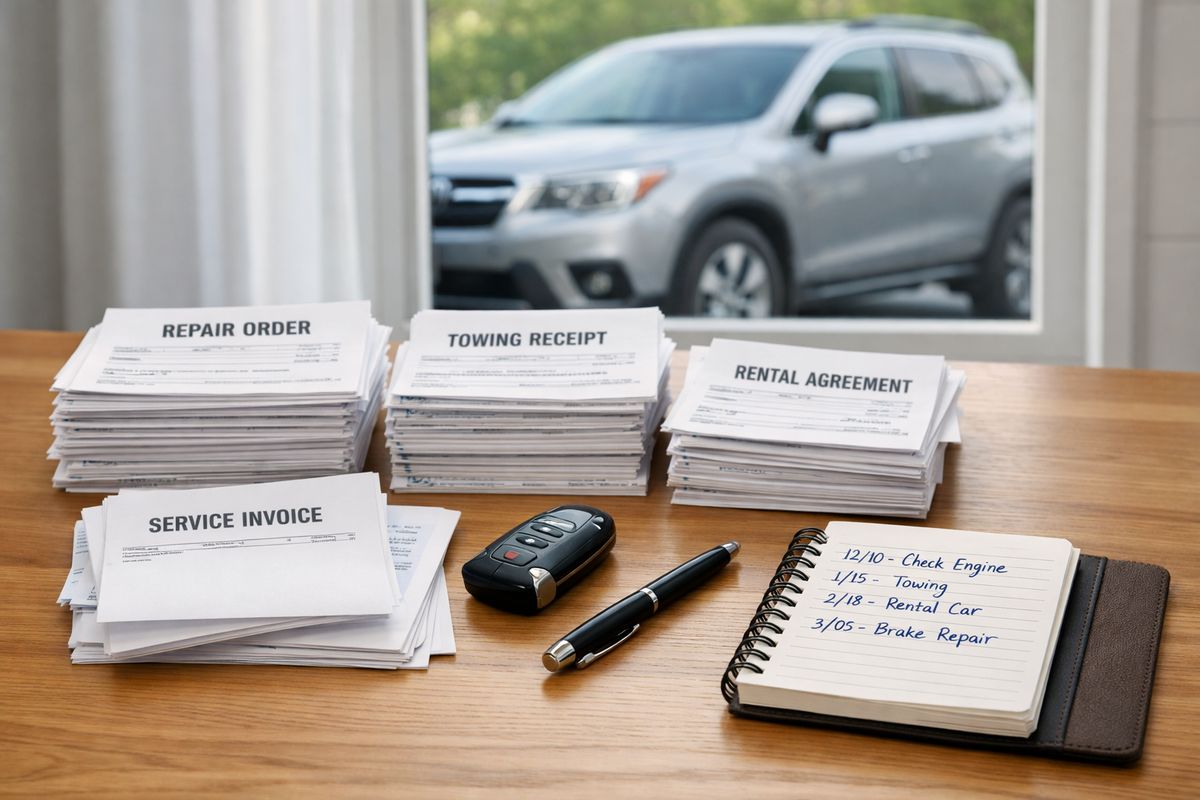
Paperwork matters more than memory. Save every repair order, final invoice, pickup receipt, tow bill, rental receipt, and every text or email about delays, diagnosis, backordered parts, or repeated visits.
Even a short message saying “part still not in” can matter later. If you want a clearer sense of what records help, look at the documents that often support a vehicle defect claim.
Make sure the complaint is written clearly each time
Specific wording makes a huge difference. “Check noise” is weak. “Transmission shudders at 35 to 45 mph after warming up” is much better. “Engine stalls after idling at red lights with AC on” is stronger than “vehicle acting up.”
The trick is to describe symptoms, timing, speed, temperature, and conditions. That kind of detail gives the repair history a spine.
Go back for the same issue and stay consistent
If the same defect comes back, say that clearly on the next visit. Do not let the issue get rewritten from scratch every time. A continuing transmission slip should stay a continuing transmission slip, not become “customer states drivability concern” on one visit and “slight hesitation” on the next.
Consistency helps show this is one unresolved problem, not a bunch of unrelated complaints. That is especially useful when deciding whether it still makes sense to return to the dealer again.
Ask for escalation beyond the service advisor
If the service lane keeps brushing you off, move up the chain. Ask for the service manager. Contact manufacturer customer care. Request a case number. Push for review beyond the person at the counter saying “we couldn’t duplicate it.”
Sometimes the issue is not just the defect. It is the fact that nobody is taking ownership of it.
Track days out of service
Count every day the vehicle is unavailable because of diagnosis, repair, waiting on parts, or waiting on approval. Do not guess. Keep a running total.
A vehicle that is gone for 22 days over two visits tells a much stronger story than “it felt like forever.” If your car has effectively disappeared into the shop, it helps to understand when downtime becomes a serious legal fact.
Signs your vehicle may qualify for a buyback, replacement, or compensation
At some point, another repair attempt stops feeling like the answer. That is often when buyback, replacement, or compensation starts to come into the picture.
Buyback
A buyback usually means the manufacturer takes the vehicle back and refunds eligible amounts, often with certain deductions or offsets depending on the facts. This is the outcome many frustrated owners are really hoping for because it ends the cycle.
Replacement vehicle
A replacement is less common, but it can happen. In that setup, you receive a comparable vehicle instead of a refund. For some people, that works well. For others, a refund makes more sense.
Cash settlement or compensation
Sometimes the result is cash compensation while you keep the vehicle. People often call this a cash-and-keep resolution. It can make sense when the defect history is real, but a buyback or replacement is not the best fit. If that option is on your radar, it helps to understand when keeping the vehicle and receiving money may be the better outcome.
Why traded-in vehicles can still matter
A lot of drivers assume trading in the vehicle ends the story. Not always.
If you traded in a defective vehicle at a loss because you were tired of failed repairs, the history may still matter depending on timing, warranty coverage, and records. Trading it away does not automatically erase what happened before.
Florida-specific issues to know
Florida drivers with 2024 through 2026 vehicles should pay close attention to timing, repair history, and the type of defect involved.
Newer vehicles in florida
Newer vehicles usually get the strongest protection when defects show up early and continue despite repair attempts during the applicable coverage period. That is why early documentation matters so much. Waiting too long to organize your records can make an already frustrating situation harder to sort out.
If you are trying to figure out the bigger picture, start with how Florida vehicle defect rules generally work.
Leased vehicles count too
A leased vehicle can still qualify. The issue is the defect and the repair history, not whether you bought or leased the car. Too many lessees assume the car is not really “theirs” for this purpose and give up too early.
Engine and transmission replacements are major red flags
An engine or transmission replacement is a big deal. It does not automatically prove your case, but it is a major sign that the vehicle had a serious problem. And if the replacement does not solve the issue, the situation often gets stronger, not weaker.
That is especially true if your engine was replaced and the trouble kept going or if the transmission still slips, jerks, or fails after major work.
Common dealer responses, and what they usually mean
Dealership language can make a bad situation even more confusing. A few phrases come up again and again.
“Could not duplicate concern”
This usually means the technician did not reproduce the problem during testing. It does not mean the problem is imaginary.
Intermittent issues are real issues. If possible, document the symptom with photos, videos, dates, weather conditions, speed, and what the vehicle was doing right before it happened.
“Operating as designed”
This phrase often shows up when a dealership wants to normalize a complaint. But wording alone does not turn repeated stalling, harsh shifting, overheating, warning lights, or slipping into normal behavior.
“We’re Waiting on parts”
Parts delays happen. That does not make the situation harmless.
If your vehicle sits for weeks because a needed component is backordered, you are still dealing with a vehicle you cannot properly use. Warranty obligations do not disappear just because the supply chain is messy.
“One more repair should do it”
Maybe. But maybe not.
If the history already shows a pattern of failed repairs, you do not have to view each new promise as a fresh start with no memory attached. At a certain point, the repair record speaks for itself.
Questions that come up all the time
Do you have to keep giving unlimited repair chances?
No. Not forever. Repeated failed attempts and extended downtime can reach a point where other remedies may apply.
What if the problem started near the end of the warranty?
That timing still matters. A defect reported during the warranty period can remain important even if the repair process spills past the warranty end date.
What if your car has been in the shop for weeks?
Long downtime can be just as important as the number of visits, especially if the vehicle is unusable or waiting on parts.
What if the vehicle was used or certified pre-owned?
Possible rights may still exist, but coverage depends on warranty status, what was sold with the vehicle, and the repair history.
The best next step if You’re tired of going back to the dealer
If you are done hearing “we fixed it” when nothing is actually fixed, gather the basics in one place: your vehicle’s year, make, and model, the repair dates, how many times it has been in for the same problem, and how long it has been out of service. That one step can bring the whole picture into focus fast.
Talk to Jonathan About Your Vehicle
Jonathan D. Schwartz, the attorney behind Bad Vehicle, helps vehicle owners understand their Lemon Law options. He can review your repair history, answer your questions, and help you determine the next steps for your potential claim.
Your case review is free, and you pay no attorney fees unless you win.
Schedule your free consultation with Jonathan: https://badvehicle.com/schedule-your-consultation/
Frequently asked questions
Can a vehicle qualify if the dealer says nothing is wrong?
Yes. “No problem found” does not automatically end the issue. If the symptoms keep happening and your repair history shows repeat complaints, the facts can still matter.
Does a major repair like an engine replacement end the claim?
No. A major repair can actually highlight how serious the defect was. If the vehicle still has related problems afterward, the replacement does not erase the history.
Do repair orders matter if the dealership already knows the problem?
Yes. What is written down matters because it creates the record. If the paperwork is vague, the history can look weaker than it really is.
Can a leased vehicle still qualify for relief?
Yes. A lease does not block a claim by itself. The focus is still on the defect, the warranty, and the repair attempts.
What if you already traded in the vehicle?
A trade-in does not always wipe out your rights. Depending on timing and documentation, the prior defect history may still be worth reviewing.
Think your vehicle may qualify?
Have your repair history reviewed and find out what options may be available under Lemon Law or warranty law.